- Please do not hesitate to contact us for more information :
- +65 6570 0555
- info@bsg.com.sg

Tree Felling vs Tree Transplanting: What Should You Consider?

Crown Reduction vs Crown Lifting vs Pollarding: Which Does Your Tree Need?
October 13, 2026Tree Felling vs Tree Transplanting: What Should You Consider?
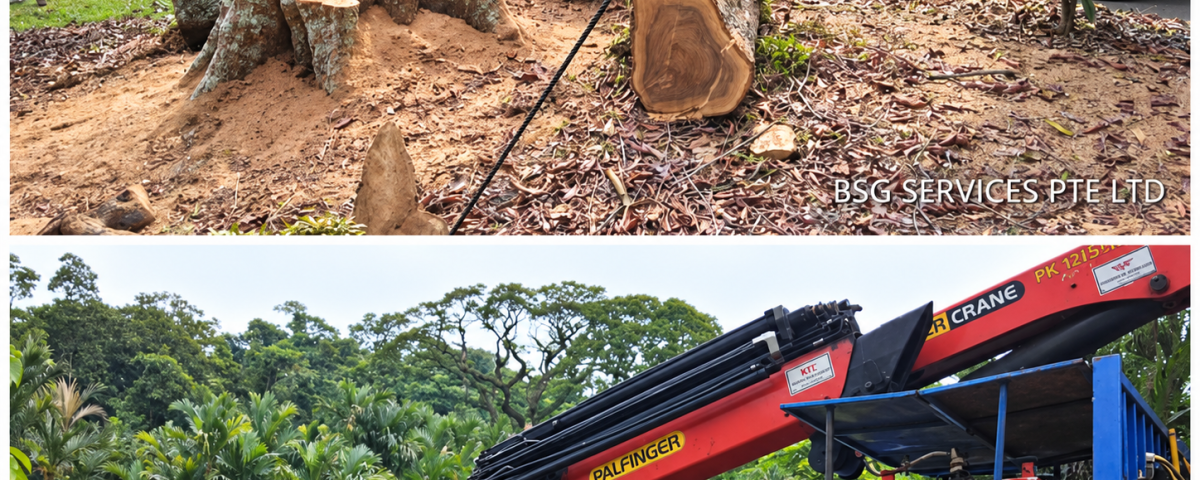
Tree felling is often treated as the default answer when a tree is in the way, yet it is rarely the only one. A tree that stands in the path of a new extension, a driveway or a drainage line can sometimes be lifted and replanted elsewhere. Which route makes sense depends on the tree, the site and the rules that apply to your land. This guide sets out what to weigh before anyone starts a machine.
Why Might a Tree Need to Be Moved or Removed?
Most requests fall into a handful of familiar categories.
- Construction or renovation: a new building, pool or access road needs the space.
- Safety: the tree is dead, diseased, leaning or has failed branches.
- Damage: roots are lifting paving, cracking drains or pressing against a wall.
- Landscape changes: a redesign calls for a different layout.
Only some of these need the tree to be destroyed. A healthy tree in the way of a project is a candidate for tree moving. A tree that is structurally unsound is usually not. The cause of the problem, rather than the inconvenience, should drive the decision.
What Is Involved in Tree Transplanting?
Tree transplanting is the careful lifting of a living tree, with a large ball of roots and soil, and its replanting in a new position. It is slow, precise work. The crown is often pruned first to cut the water the tree must supply, and the root zone is prepared weeks or months ahead where time allows.
On the day, a crane or heavy machinery lifts the tree onto a truck, and a prepared hole waits at the other end. Watering and monitoring follow for months. A moved tree puts much of its energy into rebuilding roots, so growth above ground may look slow for a season or two.
Moving a tree costs more than a quick cut and takes more planning. For a mature specimen with real value to a property, that effort often pays back.
When Might Tree Felling Be Necessary?
Sometimes there is no good alternative. A dead tree, a tree with advanced rot in the trunk or one that has split at the base is a hazard. Moving it would be unsafe and pointless, because a failing root system will not survive a lift.
In these cases, professional tree removal is the responsible choice. Cutting down trees near buildings, fences and power lines is skilled work. Crews usually take the tree down in sections, lowering each piece under control instead of letting it fall. Afterwards, stump removal stops regrowth and clears the ground for new use.

What Affects Whether a Tree Can Be Transplanted?
Several factors decide if a move will succeed.
- Species: some trees recover from root disturbance far better than others.
- Size and age: larger trees carry heavier root balls and face higher risk.
- Health: only a vigorous tree has the reserves to recover.
- Root structure: a spread that is shallow and compact is easier to lift than a deep taproot.
- Access: machines need a clear path to the tree and to the new spot.
- Season and timing: preparation works best when it is not rushed.
An arborist weighs these together. If the odds of survival are poor, they will say so plainly. In that case, tree felling may be the more honest option, perhaps paired with replanting a young tree on the same plot.
What Should Property Owners Check Before Work Begins?
Rules matter as much as technique. In Singapore, large mature trees in tree conservation areas cannot be felled without written approval from the National Parks Board. The threshold is a girth above one metre, measured 50 centimetres from the ground. Penalties for removing a protected tree without permission can be heavy.
Run through this short checklist first:
- Approval: confirm whether your tree or site falls under any protection.
- Ownership: make sure the tree sits on your land and not a neighbour’s.
- Management rules: condominiums and estates may need council or management consent.
- Services: check for cables, pipes and drains near the roots and branches.
- Contractor: choose a team with the right equipment, insurance and trained climbers.
The Ministry of National Development has spoken about the tree cutting and replanting steps expected in residential estates, which shows how seriously the rules are taken.
FAQs About Tree Moving and Removal
Can any tree be transplanted?
No. Healthy, well-sized trees of tolerant species have the best chance. Dead or unstable trees should be removed.
How long does a transplanted tree take to settle?
Often a season or two. During that time it needs regular watering and checks.
Do I need permission to fell a tree on my own property?
It depends on the size, location and protection status of the tree. Check with NParks before any cutting begins.
Is felling always cheaper than moving?
The upfront cost is usually lower, but a valuable mature tree can be costly to replace.
Talk to Us About Your Tree
Request a site assessment to discuss the options for your tree. Our arborists will inspect the site, explain what is possible and advise whether tree felling or a move is the better path.