- Please do not hesitate to contact us for more information :
- +65 6570 0555
- info@bsg.com.sg

Crown Reduction vs Crown Lifting vs Pollarding: Which Does Your Tree Need?

NParks Tree Conservation Area Rules: What Property Owners Must Know Before Tree Transplanting in Singapore
May 20, 2026Crown Reduction vs Crown Lifting vs Pollarding: Which Does Your Tree Need?
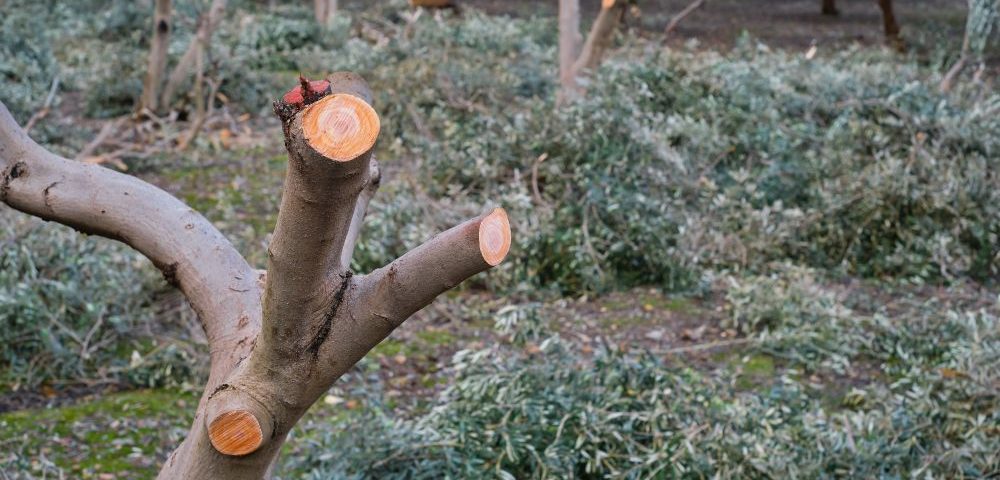
Every tree in Singapore grows against a clock of rain, wind and tight urban space. Tree crown reduction is one of three pruning methods that owners hear about most, and the names are easy to confuse. Each method changes the canopy in a different way, and each suits a different problem. Choosing wrongly can leave a tree weaker, uglier or both.
What Is Tree Crown Reduction?
A crown is the spread of branches and leaves above the trunk. Reducing it means shortening the outer branches back to suitable growth points, so the tree becomes smaller but keeps its natural shape. Done well, the cuts are clean and spread evenly through the canopy.
The aim is to lessen weight and wind resistance. Our team offers tree crown reduction for mature trees that have outgrown their space, lean over roofs or threaten power lines. According to the Ministry of National Development, crown reduction on mature trees is carried out ahead of bad weather to manage height and cut wind resistance. Crown reduction pruning is not the same as topping, which removes the main limbs and leaves ugly stubs.
What Is Crown Lifting?
Crown lifting raises the canopy by removing the lowest branches. The upper crown stays as it is. A crown lift tree is easier to walk under, easier to drive past and lets more light reach the ground below.
Owners usually ask for crown lifting when low limbs block a pavement, a signboard, a driveway or a window. Only a modest share of the canopy should come off. Take away too much and the tree loses the leaf area it needs to feed itself.
What Is Pollarding?
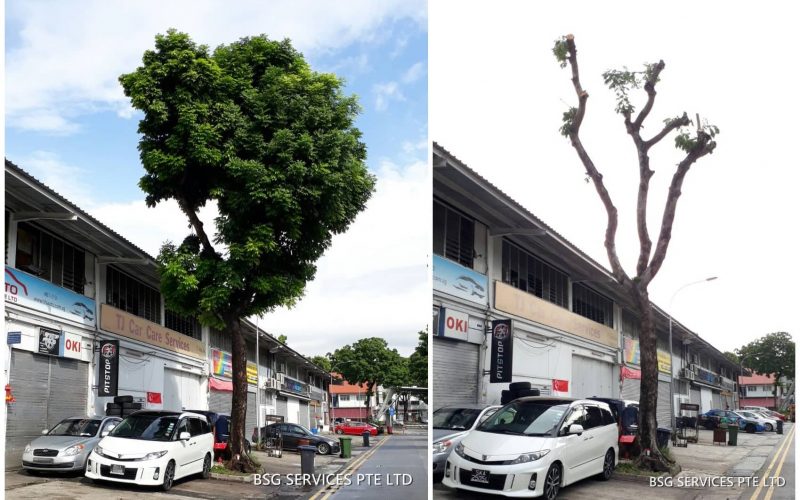
Pollarding is the most severe of the three. The branches are cut back hard to the same points, again and again, so the tree forms a knuckled framework with a fresh flush of slender shoots each season. Old European towns have pollarded their street trees this way for centuries.
It only works on species that tolerate it, and it must begin while the tree is young. Pollarding an old tree that has never been cut can shock it badly. It is a long commitment, because the shoots need cutting on a regular cycle for the life of the tree.
How Do the Three Methods Compare?
The list below is a quick way to tell them apart.
· Crown reduction: shortens the whole canopy. Best for oversized trees. Result: smaller, natural form.
· Crown lifting: removes low branches only. Best for clearance. Result: higher, open canopy.
· Pollarding: cuts back to fixed points on a cycle. Best for suitable species kept small. Result: compact framework with dense regrowth.
Crown trimming is a general term some people use for all three, which is why the language gets muddled. The method matters more than the label. For lighter upkeep, ordinary tree pruning of dead or crossing branches may be all you need.
Which Method Is Suitable for Your Tree?
Start with the problem you want to solve.
· Tree too tall or heavy: crown reduction is usually the answer.
· Low branches in the way: a crown lift is the gentler choice.
· Small space and a species that copes with hard cutting: pollarding may work, if begun early.
· Dense canopy but good size: thinning may be better than any of the three.
Species, age, health and the position of the tree all change the answer. A fast-growing rain tree behaves very differently from a slow, mature angsana. The National Parks Board also warns that excessive pruning can harm a tree and weaken its hold in strong winds, so more cutting is never automatically better.
Lee Kuan Yew once remarked, “The greening of Singapore is one of the most cost-effective things we did.” A tree pruned with care keeps earning that return. A tree cut carelessly becomes a liability.
Why an On-Site Assessment Matters
A photograph tells you the shape of a tree. It does not tell you what is going on inside the trunk, at the root plate or in the union where two stems meet. An arborist standing beside the tree can check for decay, cracks, fungal growth, root damage and past bad cuts.
That inspection decides how much can safely be removed. It also shows whether pruning will help at all, or whether the tree has a defect that needs a different plan. Trees in conservation areas may also face rules on cutting, so it pays to check before the saw comes out.
FAQs
How much can be taken off in a crown reduction?
Arborists generally avoid removing more than about a quarter of the live crown in one session. The right figure depends on the species and its health.
Will pruning kill my tree?
Correct pruning rarely does. Heavy, badly placed cuts are what cause decline and decay.
How often should a tree be pruned?
Most mature trees need attention every two to three years. Pollarded trees need cutting on a fixed annual or biennial cycle.
Can I prune the tree myself?
Small branches within reach are fine. Anything large, high or near power lines should be left to trained climbers with proper equipment.
Ready to Decide?
Request a tree assessment and a recommendation for the appropriate pruning method. Our arborists will inspect your tree and explain whether tree crown reduction, a crown lift or another approach suits it best.